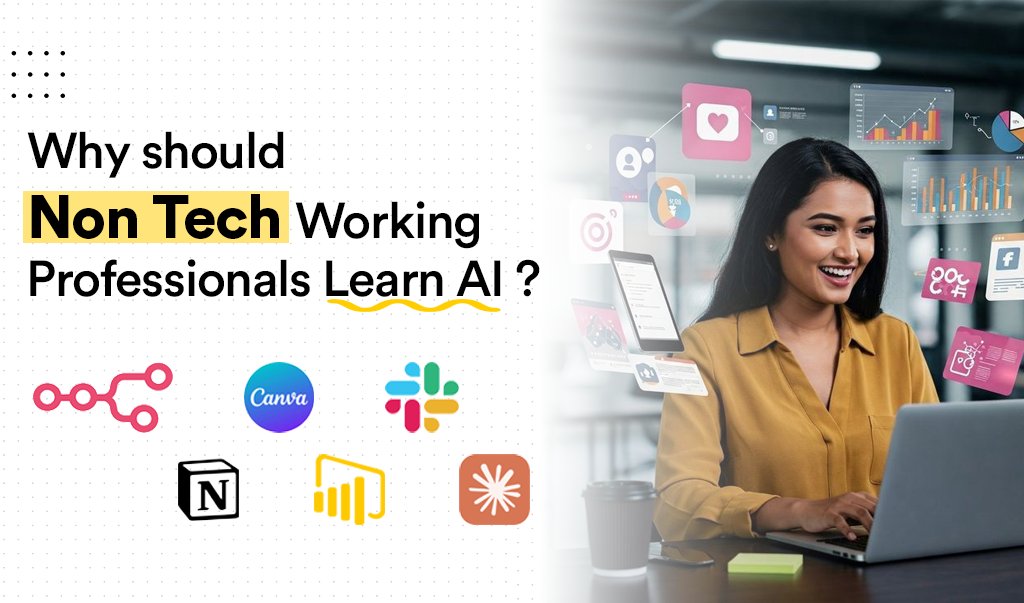
Why Non-Tech Working Professionals Should Learn AI ?
1. The workplace is shifting, fast
AI isn’t a “tech trend” anymore. It’s now part of daily work across marketing, HR, finance, operations, sales, consulting, customer success, support, and even creative roles.
If you know how to use AI tools, you don’t just work faster - you become the person who solves problems others can’t.
2. What’s really changing
Here’s what AI is doing in every industry right now:
Automating repetitive tasks
Speeding up decision-making
Personalizing customer experiences
Reducing manual research
Improving communication and documentation
Turning teams more productive with fewer resources
You don’t need coding for any of this. You just need to know what to use and how.
Benefits for Non-Tech Professionals
1. Higher productivity without extra effort
AI helps you finish work that takes hours… in minutes.
Examples:
HR drafts JD, offer letters, policies instantly
Marketers generate campaigns, creatives, captions
Sales teams prep pitches and qualify leads faster
Operations manage SOPs, reports, dashboards
Finance teams analyze numbers and create insights
The result: you become the “go-to” person in your team.
2. Stronger decision-making
AI can analyze data, summarize reports, and highlight risk/opportunities.
You don’t need to be a data scientist - you just need the right prompts.
3. Better communication
From emails to presentations to client notes, AI gives you clean, sharp writing and visuals that look professional.
4. Future-proof skills
AI literacy is now becoming a basic requirement.
Learning it early puts you ahead of the talent curve.
How AI Expands Your Career Scope
1. Promotions and leadership roles
AI-comfortable professionals are more efficient, more confident, and more valuable.
Companies want people who can lead AI-enabled teams.
2. Freelancing & side gigs
AI unlocks new ways to earn:
content creation
automation setup
social media management
research support
virtual assistance
presentation design
workflow optimization
3. Switching career paths
Even if you come from a completely non-tech background, you can move into:
AI operations
automation specialist
AI content strategist
prompt engineer
workflow designer
business analyst
These roles focus on tools, logic, and problem-solving — not coding.
Advantages of Learning AI
You save time every single day
You reduce errors and improve output quality
You take on more projects confidently
You handle complex work more easily
You get noticed by leadership
Your CV becomes instantly stronger
You stay relevant even as roles change
Disadvantages (the honest part)
Not everything is perfect. Here’s what to be aware of:
You may depend too much on tools if you don’t understand basics
Learning too many tools at once kills productivity
AI outputs still need human judgment
You must learn prompt structuring — it’s a skill
Not adapting now means you fall behind faster
Should you worry about job loss?
A little bit, yes - and that’s the wake-up call.
AI isn’t replacing people.
It’s replacing tasks.
Which means:
People who use AI will replace people who don’t.
The ones who learn now become irreplaceable.
The ones who delay risk stagnation.
What AI Tools Should Non-Tech Professionals Learn?
Start with practical, everyday tools:
1. AI Assistants
ChatGPT
Gemini
Claude
Microsoft Copilot
2. AI for Writing & Communication
Notion AI
Grammarly
Jasper
Writer
3. AI for Slides & Design
4. AI for Data & Reports
ChatGPT Code Interpreter
SheetAI / Excel AI
Power BI AI Insights
Tableau with AI
5. AI Automations
Zapier
Make.com
n8n
Copilot Studio
6. AI for Workflows
Airtable AI
Notion AI databases
Slack AI
Trello automation
With just these tools, you can automate 40–60 percent of your repetitive work.
How AI Can Transform Your Future Opportunities
1. You stand out in interviews
Saying you “know AI tools” signals you are fast, modern, and adaptable.
2. You become more valuable than your job title
Companies love people who reduce workload without increasing headcount.
3. You get access to new roles
AI-enabled job profiles are increasing every quarter.
4. You future-proof your earning potential
AI-skilled professionals earn 20–40 percent more in many roles because they deliver more in less time.
APPLY NOW - https://luc.to/blog2
Final Takeaway
If you’re a non-tech working professional, learning AI isn’t about chasing trends anymore. It’s simply about staying capable in a workplace that’s changing around you. The moment you understand how these tools fit into writing, research, communication, workflows, and decision-making, your work starts feeling lighter… and your opportunities start opening up.
Here’s what many people eventually realise: you don’t need to become a coder to use AI well. You just need someone to show you the right tools, the right workflows, and the right habits. That’s exactly why we built the Executive AI Generalist Programme - a space where non-tech professionals learn everything they actually need for real-world work: everyday AI tools, automation basics, promptcraft, workplace workflows, and the Create-Build-Launch approach that helps you apply what you learn immediately.
Nothing fancy. No jargon. Just practical skills that make your work easier and your future clearer.
If you want a structured way to start mastering AI without getting overwhelmed, this is a simple place to begin.
APPLY NOW - https://luc.to/blog2